
The Rural Healthcare Workforce Gap Is Growing. Here’s Where VR Training Fits In
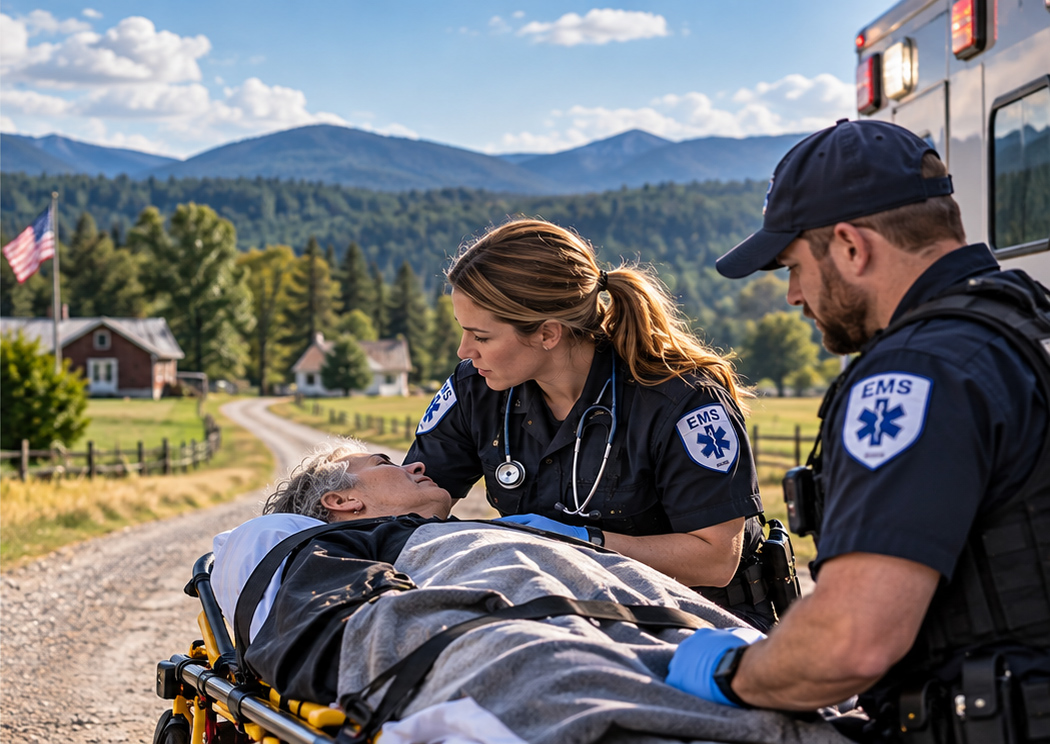
Nearly two-thirds of the country’s primary care shortage areas are considered rural, with non-metro nursing shortages projected to hit 24% by 2028, nearly five times the metro rate. Behind those numbers are rural communities often waiting longer and traveling farther to be seen by, or transported to, the nearest healthcare professional or hospital.
The Access Gap Is Also a Training Gap
Rural areas average 5.1 primary care physicians per 10,000 residents, versus 7.9 in urban areas. Behind the numbers is a root cause that gets less attention: a training gap. Rural EMS agencies and nursing programs run too few of the rare, high-stakes calls for skills to stay sharp between them, what researchers call the “low-volume competency” problem. Training costs don’t fall with volume either. It tracks headcount more than call count, so a small agency carries close to the same training bill as a busy one, on a fraction of the revenue.
Rural personnel frequently have no local training options. To add to that challenge, roughly 10 to 13% of the recertifying EMS workforce are volunteers. In a small agency, the training officer is often also the scenario writer, the instructor, and the purchaser.
Equitable healthcare isn’t only about where a patient can get care. It’s about whether the people delivering that care can train close to home, and whether a public health workforce drawn from rural and diverse communities gets the reps it needs to stay ready.
Backed by Real-World Adoption
Rural workforce organizations are already investing in VR to close this gap. The National AHEC Organization is using nearly $2 million in U.S. Department of Labor funding for Project PAVE, bringing VR-based health career training to rural and diverse communities. Researchers are documenting the same shift: a 2025 thematic analysis in JMIR Medical Education traces the growing adoption of immersive VR simulation across health professions education. VR simulation is moving from novelty to a recognized tool for reaching learners traditional infrastructure can’t.
How VR Training Helps Rural Agencies
- No travel required. Train wherever the headset, or browser, goes.
- Safe, repeatable practice for the calls that don’t come often: trauma, behavioral health crises, and overdoses, rehearsed without risk to a real patient.
- No construction required. The program’s own rules bar new construction and major capital improvements, but they don’t bar training that doesn’t need a building.
- Consistent training across every site an agency serves, even a hundred miles apart.
Funding Is Moving. Here’s How It Works
The Rural Health Transformation (RHT) Program is a $50 billion federal fund running through fiscal year 2030. The Centers for Medicare & Medicaid Services (CMS) awarded all 50 states in December 2025, with first-year awards averaging around $200 million each. Each state received its award and wrote its own plan for passing the money along, and many are still deciding how.
One thing worth knowing if your organization sits outside a rural county: sub-awardees don’t have to be rural located. States can pass funds to universities, health departments, and provider associations wherever they’re based. What matters is whether the funded work improves access, quality, or outcomes for rural residents, not where the applicant sits.
Nebraska’s Rural VR & Skills Acceleration Network ($4.8M/year) funds a statewide simulation network built on portable VR/AR technology, Oregon has paid out $502,000 for EMS simulation training, and Kentucky’s Adair County Ambulance Service won $438,418 for high-fidelity simulators. Training and technical assistance for technology-enabled care is one of the program’s permissible use categories, and new construction is not: a state can’t build a simulation center with this money, but it can buy training that doesn’t need one.
Eligibility varies by state, and even “rural” itself has no single federal definition, so it’s worth confirming your specific status. The Rural Health Transformation Program’s grant tracker and CMS’s official Rural Health Transformation Program page are useful starting points.
Rural communities don’t need a lower standard of training; they need a more accessible one. VRpatients lets instructors build a completely new case from scratch and run it in a browser, a headset, or mixed reality, with 50+ ready-made scenarios. Nurses, EMTs, paramedics, and first responders can rehearse high-stakes scenarios safely, and VRpatients works with rural and diverse programs through partnerships and pilots, with grant funding often covering the rest.
Request a demo to see how VRpatients, and your state’s grant funding, can support your team.