
Introducing VIP: Why Multi-Character Simulation Is the Next Step in Healthcare Education
Real patient care is dynamic.
Providers are not just communicating with patients; they are coordinating with colleagues, answering family members’ questions, gathering information from bystanders, and making clinical decisions all at once. Traditional virtual simulations have not always reflected that reality.
VRpatients’ latest software release changes that.
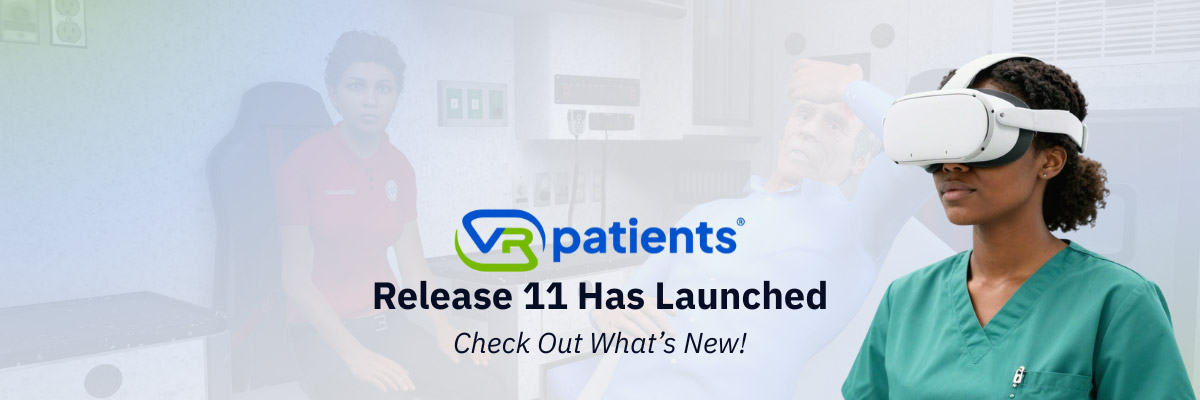
The newest update introduces “VIP,” or Virtual Interactive Person, a multi-character simulation that allows educators to add a second AI-powered character to any scenario. Whether it’s a family member, colleague, bystander, instructor, or another healthcare professional, learners must now communicate with multiple people while providing patient care. The result is a simulation that more closely reflects what happens in real clinical environments.
“This update expands simulation beyond clinical tasks and procedures by giving learners meaningful opportunities to communicate, collaborate, and advocate within complex patient-care situations,” said Paul Mazurek, RN, BSN, M.Ed., CCRN, CFRN, CHSE-A, NRP, and Nursing/EMS Specialist for VRpatients. “These skills are often underdeveloped in traditional education, yet they are essential to safe, effective care. Learners can now practice them in a supportive environment where it is safe to struggle, reflect, and improve before entering the clinical setting.”
The new VIP isn’t simply another avatar standing in the room. Each character has unique dialogue, animations, and AI-driven, emotive communication. Students must assess the patient while navigating distractions, answering questions, gathering information, and communicating effectively with everyone involved.
The update also introduces improvements to AI conversations throughout the platform. Patient interactions are now more responsive, allowing conversations to evolve naturally based on what the learner says and does. Instead of following predictable dialogue paths, scenarios become more dynamic, encouraging stronger communication skills alongside clinical judgment.
While interacting with our patient avatars, you will also notice improved physical features, hairstyles, and expanded clothing options, including scrubs, EMS uniforms, and fire department uniforms. A new patient avatar, “Leah,” along with the addition of Latin American Spanish voices, further expand the diversity and flexibility of the patient library.
With multi-character simulation, smarter AI conversations, enhanced realism, and improved educator tools, VRpatients continues to expand what’s possible in virtual simulation. Whether using a web browser, VR, or mixed reality, educators can now create richer clinical experiences that prepare learners for the situations they’ll encounter long before they care for real patients.
Ready to see the latest version of VRpatients in action? Click here to learn more, schedule a personalized demo, or explore how immersive simulation can support your healthcare program.