
CASE STUDY:
VR Simulations and AI‑Guided Debriefing Significantly Boost Nursing Students’ Clinical Judgment

INSTITUTION
Ohio University
STUDY POPULATION
160 Nursing Students
INTERVENTION
VR Simulations + AI
Chatbot Debriefing
PRESENTED AT
AACN ACE Symposium 2026
THE CHALLENGE
Nursing programs nationwide are under significant strain. Faculty shortages, rising enrollment, and a shrinking pool of clinical placement opportunities have made it increasingly difficult to give students the hands-on practice they need before entering clinical practice.
Traditional high-fidelity manikin simulation, while valuable, carries steep limitations: hardware costs ranging from $20,000 to $100,000 per unit, mandatory faculty supervision, fixed physical spaces, and scenarios that learners can eventually “game” after repeated exposure. Researchers at Ohio University set out to evaluate whether immersive VR simulation—combined with AI-guided reflective debriefing—could close these gaps at scale.
THE SOLUTION
Doctoral student Oussema Dhieb and the Ohio University Instructional Technology program partnered with VRpatients® to design a mixed-methods study with 160 junior-level nursing students across three conditions:
Control · n = 19
Traditional instruction only
VR-ONLY · n = 70
Five VR simulation sessions on the VRpatients platform, featuring
curriculum‑aligned scenarios to hone clinical knowledge and judgment
VR+AI · n = 71
The same five VR sessions plus five structured reflective‑debriefing tasks
guided by a custom AI chatbot
developed independently to
complement and extend learning
VRpatients® provided the simulation authoring environment—accessible via web browser and VR headset— enabling realistic, customizable patient encounters with AI-driven dialogue. Scenarios spanned five clinical topics: de-escalation, chronic illness, post-op pain management, unmanaged diabetes, and prioritization and solution generation. Each VR simulation was designed so learners do more than simply “learn to beat the sim,” with configurable patient presentations that keep every encounter fresh and engaging.
For the VR+AI group, the AI chatbot guided students through post-simulation reflection—prompting self-evaluation and commitment-to-improvement exercises that deepened the learning beyond the simulation itself.
THE RESULTS
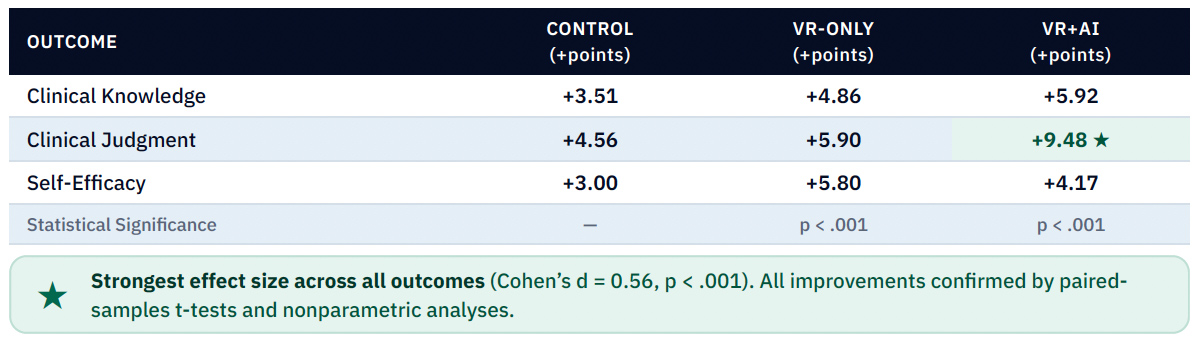
Pre- and post-intervention assessments measured three outcomes: Clinical Knowledge (CK), Clinical Judgment (CJ), and Self-Efficacy (SE). All groups improved, but the VR-based interventions consistently outperformed the control—and VR+AI produced the largest overall gains across the measured outcomes.
Student acceptance of both technologies was strong. Among the VR+AI group, 66% agreed or strongly agreed that the AI chatbot was easy to use and found it useful for their learning. Approximately 61% reported they would use the AI chatbot again if given the opportunity. VR simulation perception was similarly positive across both experimental groups.
Notably, VR simulation had its strongest impact on self-efficacy in the area of medication safety—a high-stakes competency directly tied to patient outcomes in clinical settings.
WHY IT MATTERS
This study, presented at AACN’s 2026 Access, Connection, Engagement (ACE) Symposium, provides peer-reviewed evidence that VR simulation—particularly when paired with AI-guided debriefing—can measurably improve the clinical competencies that define nursing readiness.
For nursing programs facing faculty constraints, limited sim lab capacity, or growing cohort sizes, VRpatients offers a scalable, evidence-backed alternative. Learners can complete realistic patient encounters on demand, via web browser or VR headset, from anywhere—without requiring faculty supervision for every session.
IN THEIR OWN WORDS

The VR+AI group achieved more than double the clinical judgment improvement of the control group (+9.48 vs. +4.56 points)—the strongest effect observed across all outcomes, with a statistically significant effect size of d =0.56.
What stood out most was the impact on clinical judgment. The immersive simulation gave students an authentic context to practice, while the AI-guided debriefing helped them reflect more deeply on their reasoning. That combination is especially valuable because clinical judgment is where learning becomes practice. Our goal was to help learners move beyond remembering information toward making better decisions in realistic patient-care situations, and it was encouraging to see the results support that.
Source: Dhieb, O. (2026). Implementing VR simulations and custom AI chatbots in nursing education and clinical training. AACN’s 2026 Access, Connection, Engagement (ACE) Symposium. | IRB-FY25-859 | Study conducted at Ohio University, 2025–2026